Scrimba Frontend Developer Path
What it is. 81.6 hours of interactive lessons, 13 modules, 1,493 scrims that start at "what is HTML" and end with a portfolio plus interview prep. Mozilla MDN reviewed the curriculum in 2024 and now officially recommends it. You write code inside almost every lesson instead of just watching. Most learners finish in 4 to 6 months on 10 to 15 hrs/week (full-time learners in 10 to 14 weeks; see the realistic timeline below).
Quick verdict. For a beginner who needs one ordered track to a first frontend job, this is the strongest interactive option I have seen in the Scrimba catalog. The catches: it is Pro-only, it requires real self-motivation (no live cohort, no career coach), and the certificate matters less than your portfolio.
The certificate is a nice-to-have. Your portfolio is the hiring signal, and building one is what this path is for: two path-only solo projects (Hometown Homepage and Learning Journal), then a 5.1-hour Getting hired module of 73 scrims on portfolio, GitHub, LinkedIn and interview drills. What the certificate is and is not.
Reviewed inside the path with a Pro account, September 2026: all 13 modules and 62 groups expanded.
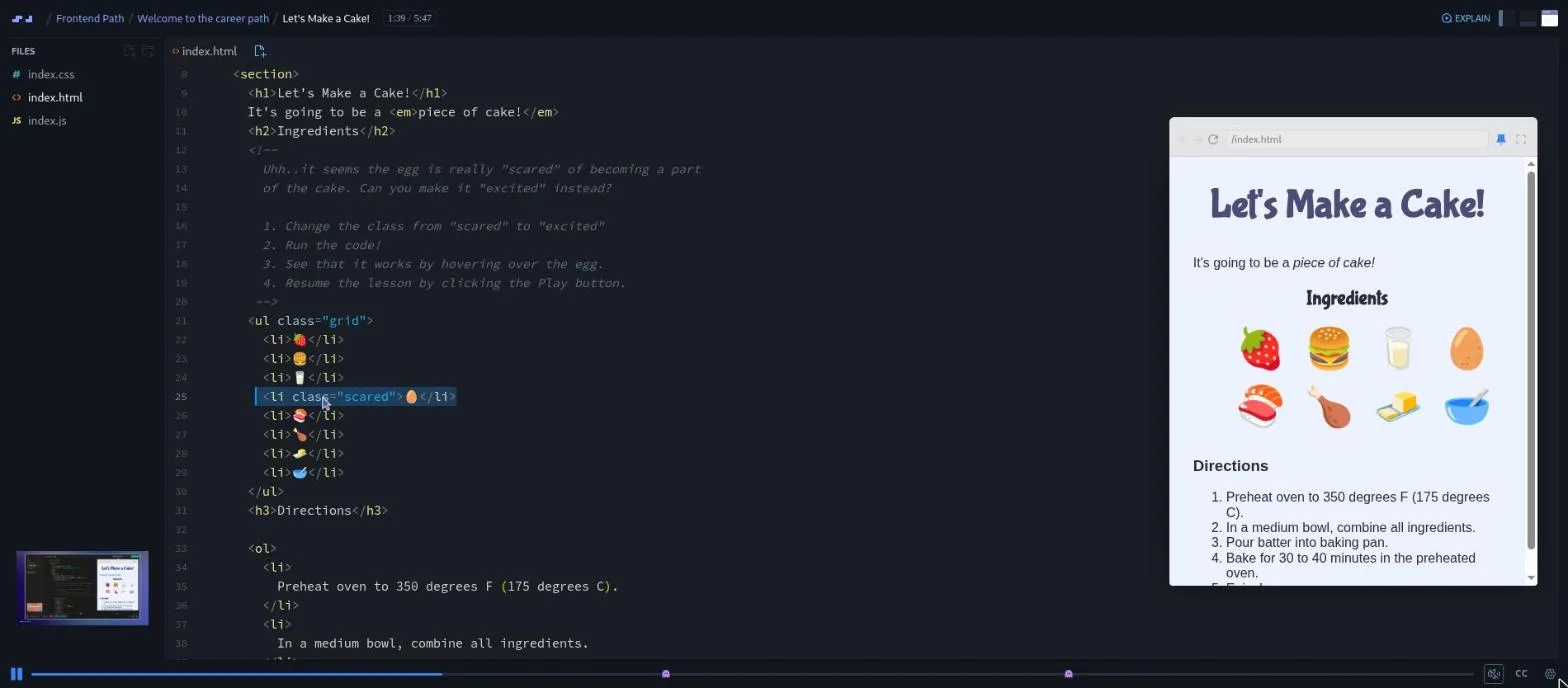 Free sample lessonPress play to open "Let's Make a Cake!", the path's platform tutorial. The two purple ghosts on the timeline are where the recording stops and you edit the code. (opens in a new tab)
What "co-created with Mozilla MDN" actually means
Scrimba's marketing language has softened over time, and the precise truth is worth knowing before you pay.
MDN did not build the curriculum. Scrimba built it. In July 2024 MDN announced that it had completed "an extensive review of Scrimba's Frontend Developer Career Path" against MDN's own Curriculum Core modules, returned feedback, and that "Scrimba implemented all of our feedback." MDN now lists the path as a recommended resource that complements its own curriculum.
It's accurate to call this MDN-reviewed and MDN-endorsed, not co-authored. That endorsement still matters. MDN is the closest thing the web platform has to a neutral standards reference, and they reviewed over a thousand scrims before signing off. If you have been burned by outdated tutorials, that quality signal is worth real money.
The 13 modules, with real durations
These numbers come straight from Scrimba's course page (scrimba.com/frontend-path-c0j) and our data/courses.json snapshot. Each module assumes you finished the previous one.
| Module | Duration | Lessons | What sticks |
|---|---|---|---|
| Welcome to the career path | 26 min | 7 | Editor setup, how scrims work, how to ask for help. |
| Web dev basics | 6.3 hrs | 80 | HTML and CSS you need before touching JavaScript. |
| Making websites interactive | 9.6 hrs | 144 | Variables, functions, the DOM. The JS interview baseline. |
| Accessible development | 95 min | 23 | Keyboard nav, ARIA, screen readers. Shows up in real job specs. |
| Essential CSS concepts | 4.5 hrs | 50 | Grid, Flexbox, layout patterns you'll reuse forever. |
| Essential JavaScript concepts | 10.6 hrs | 121 | Closures, array methods, the patterns React assumes you know. |
| Responsive design | 4.6 hrs | 54 | Mobile-first layouts and breakpoints. |
| Code reviews | 22 min | 4 | Branching, pull requests and merge conflicts with GitHub Desktop (seven scrims). |
| Working with APIs | 7.6 hrs | 96 | async/await, fetch, REST shapes. |
| User interface design | 2.5 hrs | 13 | Enough typography and hierarchy that portfolios don't all look identical. |
| React basics | 15.3 hrs | 157 | Components, props, state, with Bob Ziroll. |
| Advanced React | 13.2 hrs | 125 | Hooks, context, routing. The "mid-level React" interviewers ask about. |
| Getting hired | 5.1 hrs | 73 | Portfolio, GitHub, LinkedIn, interview prep, salary talk. |
Total: 81.6 hours. Scrimba's listing says 1,493 lessons across these 13 modules. When I expanded every group on the path page in September 2026, 1,244 scrim rows rendered; the difference is Scrimba counting clips inside scrims and a few nested items that only appear once you open a sub-module. Either way, that is lesson time only. Real builds on top push the calendar further.
What is only in the path (and not in the standalone courses)
Most of the 81.6 hours is the standalone courses stitched together in order. These are the pieces you cannot get by taking the courses one by one:
- Welcome to the career path (28 min, three sub-groups). Per Borgen's intro explains the MDN collaboration and the design of the curriculum: it "balances between the timeless and neutral web standards you need to know through the entirety of your career as a developer and the more modern tools that give you immediate employability." Then "Let's Make a Cake!", a 5:48 scrim by Tom Chant that exists purely to teach the platform, and "Your own personalized web app", six short scrims where you edit a page with your name, photos and colours before you have learned any HTML.
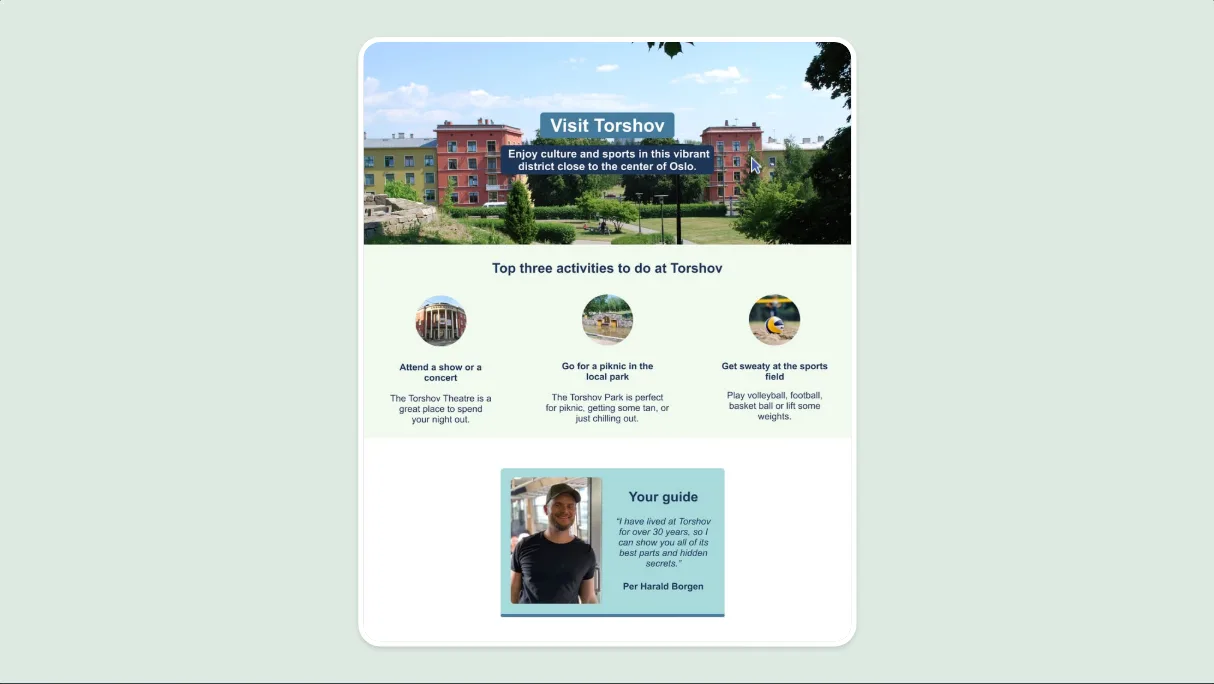
- Solo projects at the end of the fundamentals modules. "Solo Project: Hometown Homepage" closes Web dev basics: a three-section site (hero with background image, three-column activities, a guide card) with a colour palette in the CSS and a bare skeleton to start from, and a checklist of what you must use (classes, Flexbox,
background-image, the palette). "Solo Project: Learning Journal" closes Responsive design, with a deploy step. The standalone HTML and CSS course has its own solo project, but these two are path-only. - Code reviews (22 min) is not about reviewing other people's code. It is "Branching and Pull Requests with GitHub Desktop": seven scrims on issues, branches, pull requests, merge conflicts, pulling and SSH/GPG keys. Useful, but name it for what it is.
- Getting hired (5.1 hrs), five sub-modules, covered below.
- The certificate item sits as the last row of the table of contents, after "Congratulations on completing The Frontend Developer Career Path!".
Inside "Getting Hired" (the part most reviews skip)
The final 5.1-hour module is the one I think is most underrated. Expanded, it is five sub-modules: Getting hired (four scrims by Bob Ziroll: module intro, what hiring managers look for, problem solving, getting a portfolio), Using LinkedIn to get a job (twelve scrims, from the headline and summary to headshot, cover image, keywords and recommendations), Frontend job interview tips (21 scrims, mostly "Interview Question:" drills on falsy values, const vs let vs var, == vs ===, undefined vs null, spread and rest, destructuring, promises, pass by value vs reference, plus Git, GitHub, resume and job-search tips), JavaScript Interview Challenges (57 scrims) and React interview questions (twelve). It is the same material as the standalone Frontend Interview Tips, JavaScript Interview Challenges and React Interview Questions courses, wrapped by the hiring-manager talk.
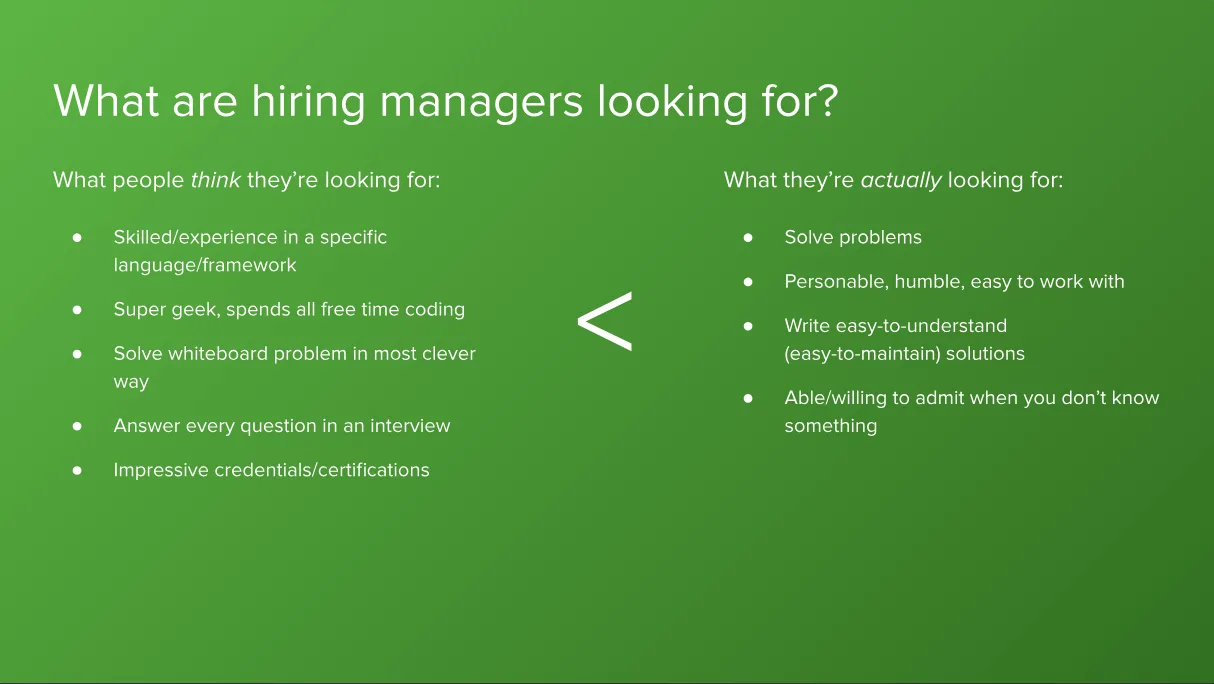
That opening talk is worth the price of the module. Bob draws on his time at V School, where he "had the chance to speak with dozens of hiring managers", and his first slide contrasts what people think managers want (a specific framework, "super geek, spends all free time coding", clever whiteboard solutions, credentials) with what they told him they actually want: people who solve problems, are "personable, humble, easy to work with", write easy-to-maintain code, and admit what they do not know. His line on stacks: "a specific skill or a specific framework or a specific language really meant almost nothing to them." It won't land you a role by itself in this market. It gets you further than the "we built five projects, good luck" ending most paths give you.
If that section interests you and you want a preview before committing, the Frontend Interview Prep guide walks through what to study after the path finishes.
Bob Ziroll, the teacher you'll spend the most time with
Roughly 35% of your lesson hours (React basics plus Advanced React, 28.5 hrs combined) are taught by Bob Ziroll, Scrimba's Head of Education. If his style does not click for you, you want to know that on day one, not 60 hours in. Sample his free Learn React course before you pay.
On Scrimba Podcast episode 82 Bob describes his approach:
"There's something that I get a lot of enjoyment out of, in taking something complex and breaking it down into simple, understandable steps for other people to learn."
And on why he insists on coding along instead of passive watching:
"Anything in this life that you have gotten good at, you've done it because you practiced, you practiced the hard parts and got better at it."
He repeats a tennis analogy in the same episode: you cannot get good by watching the pros, only by putting your hands on the rackets. That is the whole pitch for the scrim format in one sentence, and you will feel it inside the React module, where most lessons stop after a minute or two and ask you to type the next line yourself.
Per Borgen, Scrimba's CEO, made a related point on episode 140 about whether the path actually works: "People sometimes ask, 'Does it work? If I stick at it, will I be successful?' I'm like, 'Yes,' because we literally interview people after they've done it on the show." That's selection bias: Scrimba only interviews people who made it. Listen to two or three anyway; the pattern in what they say about the job hunt matters more than the podcast's framing.
Realistic time budgets
The "complete in 6 weeks" claim you see online assumes 14 hours of study per week and zero failed builds. Here's a more realistic breakdown.
| Schedule | Weekly hours | Realistic completion |
|---|---|---|
| Full-time learner | 30 to 40 hrs | 10 to 14 weeks |
| Evenings and weekends | 10 to 15 hrs | 4 to 6 months |
| Weekend-only learner | 4 to 6 hrs | 12 to 16 months |
| Casual, "when I feel like it" | Under 3 hrs | Probably never |
Add 30 to 50% on top of the 81.6 hours for projects you actually finish, bugs you have to debug yourself, and concepts that need a second pass. The 6-Month Study Plan breaks this into week-by-week targets.
If you are working full-time, also read Scrimba for Busy Professionals before committing.
What real learners say
Public, attributable reviews are thinner than you would expect for a path this popular. What's out there:
- Don the Developer's podcast review ("My HONEST Review") gives the path solid marks on format and instructor quality, and pushes back on the "you'll be hired in six months" framing common in coding-bootcamp marketing.
- Curricular.dev's review ranked it #1 for frontend learning, praising project-based progression and the peer code-review system, while noting that the certificate path requires watching every scrim.
- Rafael Nacle's Medium write-up is one of the rare first-person completion posts and is worth reading for an unfiltered learner perspective.
- Scrimba's own Class Central listing aggregates third-party ratings.
If you want raw Reddit chatter, search r/learnprogramming and r/webdev for "Scrimba frontend" directly. The pattern I see across threads: enthusiastic on format, mixed on hireability outcomes (consistent with every self-paced program in 2026), and unanimous that you have to ship portfolio projects beyond what the path provides.
Pros and cons, plainly
Pros
- MDN-reviewed curriculum (rare quality signal among paid courses).
- One spine from zero to React, no playlist hopping.
- A real 5.1-hour Getting Hired module, not a 10-minute outro.
- Active scrim format keeps your hands on the keyboard.
- Pro-only Discord channels (code reviews, instructor help) for stuck moments.
- Certificate of completion you can list on LinkedIn.
Cons
- Pro-only. No lifetime unlock for the full path. Compare with Scrimba pricing and Pro vs Free before paying, and check the student discount if you qualify.
- No live cohort, no career coach, no 1:1 mentorship. The legacy Scrimba Bootcamp service that offered this was retired.
- JavaScript-centric. No mobile (iOS/Android), no Java, no C#. If you want Node/Express in the same subscription, see Fullstack Path.
- Hireability comes from portfolio depth and your local market, not the certificate.
- The "Code reviews" module is 22 minutes of GitHub Desktop branching and pull requests, not code review. You will need outside review (the Pro Discord channels, or a peer) for real growth.
Does the certificate matter for hiring?
Short answer: not by itself. Hiring managers I have seen quoted on Reddit and in industry surveys overwhelmingly weight portfolio projects, GitHub history, and how you talk through code in interviews above any certificate from any self-paced platform (including Coursera, Codecademy, and Scrimba). The Scrimba certificate is a fine LinkedIn line item and a useful "I finished something hard" signal. It is not a credential the way a CS degree or a name-brand bootcamp is.
What the path gives you that does matter for hiring: a finished portfolio of small projects, React fluency you can demo in a live coding interview, and the habit of writing code daily. Those move the needle.
Frontend Path vs the other Scrimba paths
| Feature | Frontend Path | Fullstack Path | Backend Path | AI Engineer Path |
|---|---|---|---|---|
| Duration | 81.6 hrs | 108.4 hrs | 36.2 hrs | 11.4 hrs |
| MDN-endorsed | Yes | No (shares modules) | No | No |
| Includes React | Yes | Yes | No | Yes |
| Includes Node/Express | No | Yes | Yes | No |
| Best for | First frontend job, UI focus | Maximum breadth | Adding server skills to existing JS | Building LLM-powered apps |
Also useful: Frontend vs Fullstack: which to choose.
Standalone courses inside the path
If you only need one piece, these courses overlap with path modules:
- Learn React (free): the React Basics module.
- Learn JavaScript: JavaScript fundamentals.
- Learn HTML and CSS: the Web Dev Basics module material.
Courses in this path
The path bundles these standalone courses into one ordered track. If you want to read the individual reviews or cherry-pick, here they are roughly beginner to advanced:
- Learn HTML and CSS (Beginner, Free, 5.7 hrs)
- Learn Responsive Web Design (Pro, 15.1 hrs)
- Learn Flexbox (Pro, 53 min)
- Learn CSS Grid (Pro, 1.1 hrs)
- Learn JavaScript (Beginner, Free, 9.4 hrs)
- Advanced JavaScript (Pro, 9.8 hrs)
- The Tricky Parts of JavaScript (Pro, 59 min)
- Learn UI Design (Pro, 8.6 hrs)
- Learn Tailwind CSS (Pro, 2.2 hrs)
- Learn React (Free, 15.1 hrs)
- Learn React Router (Pro, 9.7 hrs)
- Advanced React (Pro, 13.2 hrs)
- React Challenges (Pro, 9.8 hrs)
- React Interview Questions (Pro, 41 min)
and more, see the full React catalog and JavaScript catalog.
Choose this if
You want a first frontend dev job, you learn by typing in the lesson, and you can show up consistently for several months without external accountability. Pick Fullstack instead if you want servers in the same subscription. Pick Backend if you already know UI and only need APIs and databases.
The Frontend Developer Path
ProFrontend career track endorsed by Mozilla MDN: HTML, CSS, JavaScript, React, accessibility, APIs, and a 73-lesson getting-hired module.
Start the Frontend Path (opens in a new tab)Related pages
- All learning paths
- 6-Month study plan
- Scrimba pricing
- Pro vs Free
- Is Scrimba Worth It?
- How scrims work
- Tutorial hell FAQ
- Scrimba for CS students
- Scrimba for busy professionals
- Scrimba for absolute beginners
81.6 hours of lessons. Evening learners (10 to 15 hrs/week) finish in 4 to 6 months. Full-time learners in 10 to 14 weeks. Add 30 to 50 percent on top for real project work.
Scrimba built the curriculum, MDN reviewed it in 2024 and now officially endorses it. MDN-reviewed and MDN-endorsed is the accurate framing.
No. The path starts from absolute zero.
The path itself requires Pro. The React module is available standalone for free.
Not by itself. Portfolio projects and live coding performance matter far more.
Not covered. The path is JavaScript-centric. Consider Fullstack if you want Node, or look elsewhere for mobile and JVM languages.