Scrimba AI Engineer Path
Scrimba's AI Engineer Path runs 11.4 hours across nine modules and teaches a JavaScript developer to wire LLMs, agents, retrieval, and MCP into real apps. You build a ReAct agent by hand, a RAG search over your own data, and deploy a Node app to Render. It's the smallest path on Scrimba, and the fastest on-ramp to applied AI engineering.
Reviewed inside the path with a Pro account, September 2026: all nine modules expanded, 162 scrims.
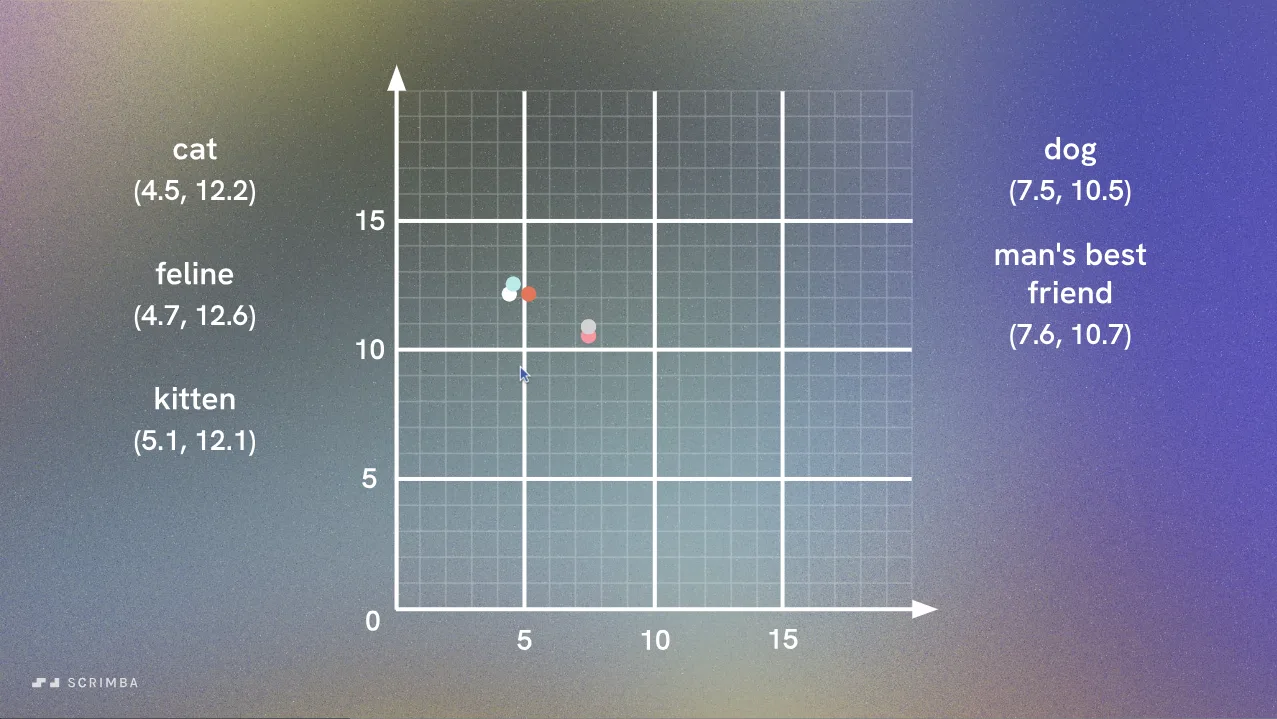 Pro lessonPress play to open "What are embeddings?", the second lesson of the Embeddings and Vector Databases module and the start of the path's RAG block. (opens in a new tab)
A focused weekend clears the lesson runtime, or roughly two weeks at an hour a day. Add a small portfolio project on top (a retrieval app, a tool-using agent, a deploy to Render) and budget another week for that.
New modules ship as the tooling evolves: the Intro and Deployment modules already carry an "updated" tag, and MCP and Context Engineering were added recently. If you already ship in JavaScript or TypeScript, this is your on-ramp. It is not a complete AI curriculum yet.
Take it if you ship JavaScript or TypeScript today and want the shortest credible on-ramp to agents, RAG, and MCP inside the apps you already build. Skip it if your goal is research, model training, or a Python-first ML track. Python is the dominant language in AI/ML, and this path does not pretend otherwise; Python learners should look at DeepLearning.AI, fast.ai, or the Hugging Face course instead. Also skip if you do not yet know React and basic web app structure; start with the Frontend or Fullstack path first.
Applied AI engineering for a developer who already ships code, not a data science degree. The path is taught by Scrimba's in-house instructors. Per Borgen, who runs Scrimba, described the structure on the Scrimba Podcast like this: "It starts with Tom Chant, our teacher, who takes you through the AI engineering basics, and that's based upon the OpenAI APIs because that's the most common ones you'll use out in the industry." After that, Borgen says, "we take a deep dive into AI agents, building these features or products that can act on your behalf, not just generate text back to you." Arsala Khan teaches the Open Source Models and Context Engineering modules; Bob Ziroll and Guil Hernandez contribute later sections.
Pro is required. Live prices, including regional discounts, are at scrimba.com/our-pricing (opens in a new tab), and the student discount applies if you are a verified student.
What the path covers
The marketing copy lists agents, RAG, and MCP. Here is the actual module breakdown, with the framing that matters once you start clicking through:
| Module | Length | What you really do |
|---|---|---|
| Intro to AI Engineering (updated) | 2.5 hrs, 34 scrims | OpenAI API basics, the messages array, streaming, few-shot prompting, temperature; the Gift Genie build. Same scrims as Intro to AI Engineering. |
| Deployment (updated) | 71 min, 14 scrims | One Node app taken from localhost to Render: push to GitHub, build command, smoke test, domain names, database problems, staging, merging, alerts, a health endpoint, process signals. |
| Open-source Models | 40 min, 9 scrims | Hugging Face Inference (summarisation, classification, image transforms), Transformers.js in the browser, running models locally with Ollama. |
| Embeddings and Vector Databases | 95 min, 20 scrims | The data side of RAG: create embeddings, store them in Supabase, similarity search, chunking, the PopChoice solo project. Same scrims as Learn RAG. |
| Agents | 117 min, 28 scrims | A ReAct agent built by hand in nine parts, then an OpenAI functions agent. Same scrims as Learn AI Agents. |
| Context Engineering | 58 min, 12 scrims | System prompts, managing and summarising the context window, with a super challenge. Same scrims as Learn Context Engineering; two scrims still carry a "Review Needed" tag in their titles. |
| Vercel AI SDK | 113 min, 20 scrims | A customer-support agent: retrieval, structured outputs, tool calling, agentic routing, web search. Same scrims as Build a Support Agent with Vercel AI SDK. |
| Model Context Protocol | 43 min, 14 scrims | MCP concepts, a server with tools and resources, transports, trust boundaries, clients. Same scrims as Intro to MCP. |
| Multimodality | 62 min, 11 scrims | Image generation (prompting, sizes, editing) and GPT-4 with Vision. Same scrims as DALL-E and GPT Vision. |
The path page header says "11.4 hrs, Intermediate, Pro, 10,000+ students, 10 languages"; the module headers add up to about 12.5 hours, and the modules hold 162 scrims (Scrimba's own lesson count, 263, is higher because it counts clips inside scrims). This page uses the 11.4-hour headline throughout. Unlike the Frontend and Fullstack paths there is no nesting: each module is one flat list, and there is no welcome module, no solo-project wrapper and no career block. Seven of the nine modules are standalone courses you can also take on their own; only Deployment and Open-source Models exist in this form only inside the path.
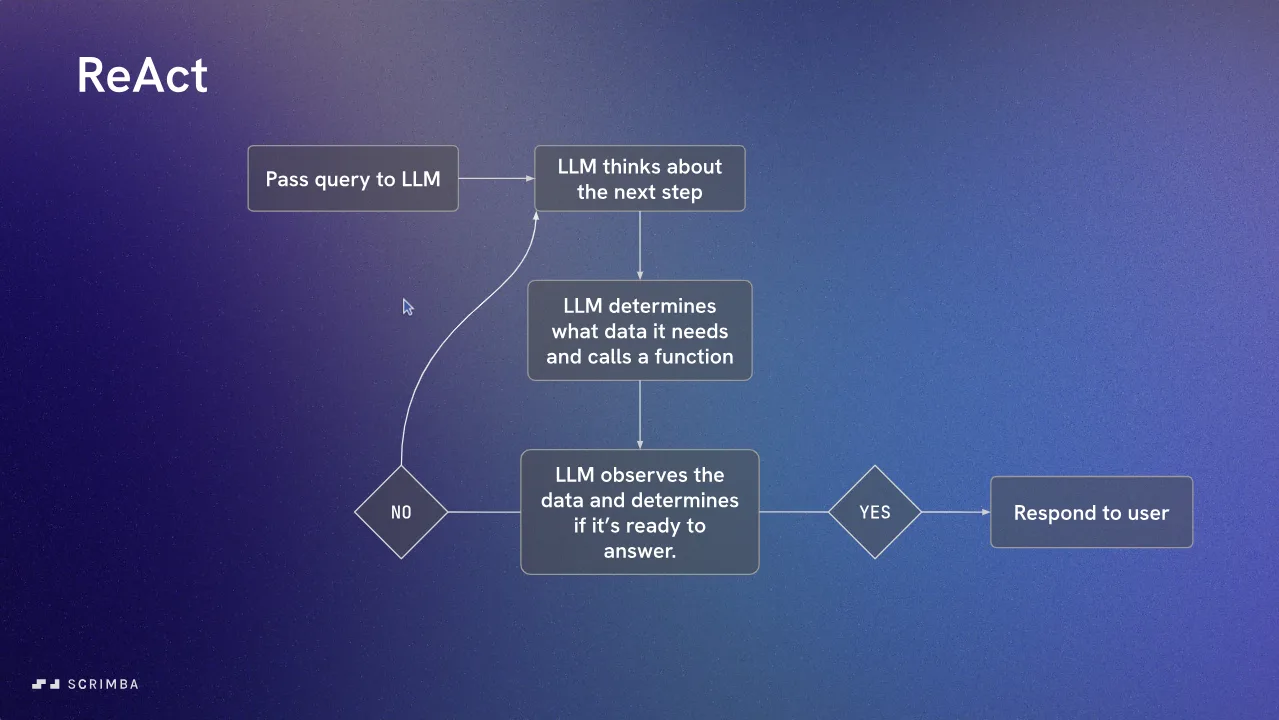
The order is the useful part. You learn the API surface first, deploy something early, then build the data layer for retrieval, then add tool-calling, then learn to manage context across it all. That's the order a real project gets built in, and it's rare for an intro course.
Why a JavaScript-first AI path matters (and where it pinches)
Python is the dominant language for AI and ML. Scrimba does not pretend otherwise. Even Scrimba's own How to Become an AI Engineer roadmap calls Python "the foundation of AI engineering" and lists LangChain, RAG, and PyTorch as the most common AI engineer skills on LinkedIn. The 2025 Stack Overflow Developer Survey put Python usage at 57.9% of all respondents, and most published AI research code is Python.
So why a JS-first path? Because the people building AI features in production web apps are mostly the same people who were building those web apps last year. The Vercel AI SDK, LangChain.js, and the official OpenAI and Anthropic JS clients exist precisely because that is where the deployment surface lives. The New Stack's Tech Hiring in 2026 piece notes that AI skills now appear in 42% of software job descriptions, up from 8% in 2022, and that the demand split is roughly between research-track ML roles (Python-heavy, PhD-friendly) and applied AI engineering roles (full-stack, integration-heavy, often JavaScript on the deployment side).
Tom Chant puts the motivation plainly on the Scrimba Podcast: "Most people are learning TypeScript not because they specifically had a use for it themselves, but because it makes them more employable. I think with AI it's the complete opposite. You're learning AI because it gives you just so much more power." If you already write TypeScript daily and you want to add LLM features to the apps you already ship, this path takes you from "I have read about agents" to "I have built one" without forcing a Python detour.
The pinch is real: if your end goal is a research-engineer role at a frontier lab, this path is not enough on its own. You will need Python, math, and exposure to model training, not just inference and orchestration.
The 2026 AI engineer job market, with real numbers
What the primary trackers show:
- levels.fyi lists the median AI/ML software engineer in the US at roughly $245,000 total compensation, with the standard caveat that levels.fyi skews toward higher-paying companies because that is who self-reports.
- levels.fyi's dedicated AI Engineer title page shows mainstream-employer comp clustering in the $134k-$193k range, with frontier labs pulling the top of the distribution dramatically higher. OpenAI L2 to L6 runs from roughly $251k to $1.28M total comp, median around $555k. That bifurcation, enterprise vs. frontier lab, is the most important shape to understand in the current market.
- PwC's 2025 Global AI Jobs Barometer found a 56% wage premium for AI skills, up from 25% the year before.
- Stack Overflow's 2025 Developer Survey confirmed that AI tool fluency now correlates with measurable comp lift across general software roles, not only specialised ML titles.
What employers want from candidates targeting the applied side (the side Scrimba's path serves) is a small portfolio: a retrieval app over real documents, a tool-using agent with at least one external API, a deployment that handles streaming responses, and a writeup of where the system failed and what you did about it. The path is sized to give you the components for exactly that. It is not sized to give you a research portfolio.
How the path compares to the obvious alternatives
vs. DeepLearning.AI short courses. DeepLearning.AI's catalog is the gold standard for free, focused AI courses, mostly Python notebooks against OpenAI or Anthropic APIs. If you are comfortable in Python and want depth on one topic at a time, start there. Scrimba's advantage is sequence and JavaScript; DeepLearning.AI's is depth, instructor pedigree, and price.
vs. official Anthropic and OpenAI cookbooks. The Anthropic Cookbook and OpenAI Cookbook are reference implementations from the vendors. They are not pedagogical and assume you already know the language. Scrimba's path gives you scaffolding so the cookbooks make sense afterward.
vs. Python-first ML tracks (fast.ai, Hugging Face course, Coursera ML). Those teach you how the models work, not just how to call them. If your aim is to train, fine-tune, or interpret models, start there. The Scrimba path treats models as services.
Where the path falls short
- Eleven hours is small. The Frontend Path is roughly 82 hours, the Fullstack Path is closer to 108. The AI Engineer Path is the smallest path on the platform by a wide margin. The discipline is young, and Scrimba is still building the path out. Treat it as a structured first pass, not a complete curriculum.
- The field moves fast and some parts will date. MCP is still emerging. Vercel AI SDK had breaking changes through 2025. Whatever is recorded today will need a refresh in twelve months. Scrimba does re-record modules (the Intro and Deployment modules carry an "updated" tag at the time of writing), but expect to chase release notes between updates.
- No math, no statistics depth. You will finish without knowing why a particular embedding model produces 1536 dimensions or what a softmax actually does. For applied work that is often fine. For interviews at ML-heavy companies it is not.
- Web-app focused, not ML research. Inference and orchestration only. Training, evaluation, and fine-tuning beyond a surface mention are out of scope.
- You need Pro. The free Intro to AI Engineering tutorial with Tom Chant is available without paying (free intro course), but the full path lives behind Pro. If you want the theory first, Scrimba's free How AI Works handbook (opens in a new tab) covers LLMs, prompting, embeddings, RAG, tool use, agents, and evals with a Beginner, Intermediate, and Deep Dive depth switcher. Its code leans Python while the path is JavaScript throughout, so read it as theory alongside the hands-on build, not a substitute for it.
Choose this path if
Choose it if you ship JavaScript or TypeScript today and want the shortest credible on-ramp to building agentic, retrieval-backed features in the apps you already work on. The sequence is well chosen, the JS focus is honest about its tradeoffs, and the deploy module gets you to a live URL instead of leaving you in a notebook.
Skip it if your goal is research or model training (use Python tracks), if you do not yet know React or basic backend patterns (do the Frontend or Fullstack path first), or if you want a degree credential rather than a portfolio.
The AI Engineer Path
ProAgents, RAG, MCP, Vercel AI SDK, embeddings, a Render deployment, and multimodal patterns. JS-first, no PyTorch.
Start the AI Engineer Path (opens in a new tab)Courses in this path
Seven of the path's nine modules are standalone courses too, so you can read any review or take just one. See our ranked take in the best AI engineering courses on Scrimba:
- Intro to AI Engineering (Pro, 2.5 hrs)
- Learn AI Agents (Pro, 2.0 hrs)
- Build a Support Agent with Vercel AI SDK (Pro, 1.9 hrs)
- Learn RAG (Pro, 1.6 hrs)
- Learn Context Engineering (Pro, 60 min)
- Intro to Model Context Protocol (MCP) (Pro, 37 min)
- Intro to Dall-E and GPT Vision (Pro, 1.0 hrs)
These AI courses sit outside the path. Take them before it or alongside it:
- Learn to Code with AI (Beginner, Free, 4.5 hrs)
- Prompt Engineering for Web Developers (Pro, 3.1 hrs)
- Build Serverless AI Agents with Langbase (Free, 50 min)
- Intro to Mistral AI (Free, 1.4 hrs)
Related pages
- All Learning Paths
- AI Courses Hub
- Scrimba Pricing
- How Scrims Work
- Scrimba AI Courses
- AI Tools Every Developer Should Know
No prior AI experience is needed. You do need comfort with JavaScript or TypeScript and a working knowledge of fetch, async, and basic web app structure before starting.
JavaScript and TypeScript throughout. The path is explicitly aimed at web developers wiring LLM features into apps they already build, not at Python-first ML practitioners.
The Intro to AI Engineering and Deployment modules carry an 'updated' tag, and Model Context Protocol and Context Engineering modules were added recently. Expect periodic refreshes because the underlying tooling moves fast.
Small production-shaped apps: a chat UI with streaming responses, retrieval over your own documents, a tool-using agent calling at least one external API, and a Node app deployed to Render with a staging environment and a health endpoint.
Tom Chant opens the path with Intro to AI Engineering. Arsala Khan teaches Open Source Models and Context Engineering. Bob Ziroll, Guil Hernandez, and Per Borgen contribute the remaining modules.