Scrimba Backend Developer Path
Quick verdict. For a JS frontend dev, this is the missing half of fullstack: 36.2 hours of Node, Express, SQL, and Supabase. It is not the path for Python, Java, Go, or Rust backends.
Realistic time budget. Roughly 8 to 10 weeks at 6 to 8 hours per week, 3 to 5 weeks at 12 to 15 hours per week, 2 to 3 weeks full-time. Lesson time alone is about 40 hours; real project builds push the calendar further.
Reviewed inside the path with a Pro account, September 2026: all twelve modules and their sub-modules expanded on the path page.
 Pro lessonPress play to open the path's first Super Challenge: wire up a live stock ticker from a fake API. A fair test of whether you are ready for an Intermediate path. (opens in a new tab)
Take it if you already ship a JavaScript frontend and want routes, SQL, hosting, and baseline security without re-doing the whole Frontend arc. Skip it if you want a Python/Django, Java/Spring, Go, or Rust backend; Scrimba is JavaScript-first and this path does not cover those stacks. New to JS? Start with the Frontend or Fullstack path first.
Who teaches this path
Scrimba lists Tom Chant, Gregor Thomson, Rachel Johnson, DonTheDeveloper, Jonathan Hill, Ajo Borgvold, and Shant Dashjian on the Backend path. The standalone courses that map into it tell you who leads each block:
- Node.js (3.5 hrs) and Express.js (4.0 hrs): Tom Chant
- SQL (3.8 hrs): Gregor Thomson
- Intro to Supabase (4.8 hrs): Jonathan Hill
- Cybersecurity (5.0 hrs): Rachel Johnson and Jonathan Hill
That tells you who teaches what: Tom Chant carries most of the Node and Express weight, Gregor Thomson handles SQL, and Rachel Johnson plus Jonathan Hill cover the security material.
Complete module breakdown
Skewed toward shipping APIs, not abstract CS theory.
| Module | Topics Covered | Why it matters in 2026 |
|---|---|---|
| Welcome to the Backend Path | Orientation | What "backend" means in this track. |
| Command Line Interface | Terminal basics, navigation | Servers and scripts live here. |
| Web Architecture Fundamentals | HTTP, client-server model | Request/response mental model for APIs. |
| Async JavaScript & APIs | Promises, fetch, REST | Same async patterns you'll use with DBs and routes. |
| Node | Node.js runtime, modules, npm | JS on the server. |
| Databases | SQL, data modeling, queries | Persistence and real queries. |
| Git & Github | Version control, collaboration | Standard team workflow. |
| TypeScript | Types for backend development | Fewer silly mistakes in larger handlers. |
| Frameworks | Express.js, NestJS | Route stacks without writing everything raw. |
| Cybersecurity | Auth, input safety, rate limiting | Baseline hardening interviewers sometimes probe. |
| DevOps | Deployment, CI/CD basics | From localhost to something public. |
| Launching Your Career | Backend-focused job search | Positioning projects for API-heavy roles. |
Total: 36.2 hours across 943 lessons. The path page header reads "36.2 hrs, Intermediate, Pro, 7,000+ students, 10 languages"; with every group expanded, 598 scrim rows render (Scrimba's lesson count includes clips inside scrims).
What the expanded modules contain
- Welcome to the Backend Path (40 min) is a 1:45 welcome plus "How's your JavaScript?", a 38-minute self-check built around a Super Challenge: Stock Ticker. Tom Chant explains the idea in the brief: "throughout this course, I'm aiming to break everything down into bite sized chunks. But of course, real life isn't like that." You get a fake stock API file and an
index.js, and have to render a ticker that refreshes every 1.5 seconds with a green, red or grey triangle for the price change, using a list of JavaScript concepts he keeps on a hidden slide until you have tried. If that challenge is hard, the path's Intermediate label is telling you something. - Command Line Interface (103 min) is Command Line Fundamentals (10 scrims) and Command Line Power Tools (13), the same material as the standalone Command Line Basics course.
- Web Architecture Fundamentals (72 min) is path-only: "How the Internet Works" (web and IP addresses, ports, DNS, nine scrims) and "CLI Network Tools" (resolving DNS records, testing connectivity, ten scrims).
- Node (3.6 hrs) is "Build a REST API" (Wild Horizons, 19 scrims) and "Routes & Paths" (26 scrims). Databases (3.7 hrs) is four sub-modules: an intro (SQL vs NoSQL, managed vs self-hosted), Fundamentals of SQL (25), Creating and Joining Tables (11) and Advanced Logic and Conditions (nine:
ANY,ALL, and friends), plus a scrim on ORMs. - Frameworks (6.7 hrs) is Express (Build an Express API, Build a Fullstack Express App, Authentication with 25 scrims, TypeScript & Express with 24) and Nest (21 scrims: "DevMatch, a dating app for developers").
- Cybersecurity (5 hrs) is four sub-modules: Think Like a Security-Minded Developer (STRIDE threat model), Input & Data Safety (25 scrims, starts with cross-site scripting), Authentication & Identity (stateful, stateless and delegated), and Rate limiting & throttling (27 scrims, fixed-window counters and up).
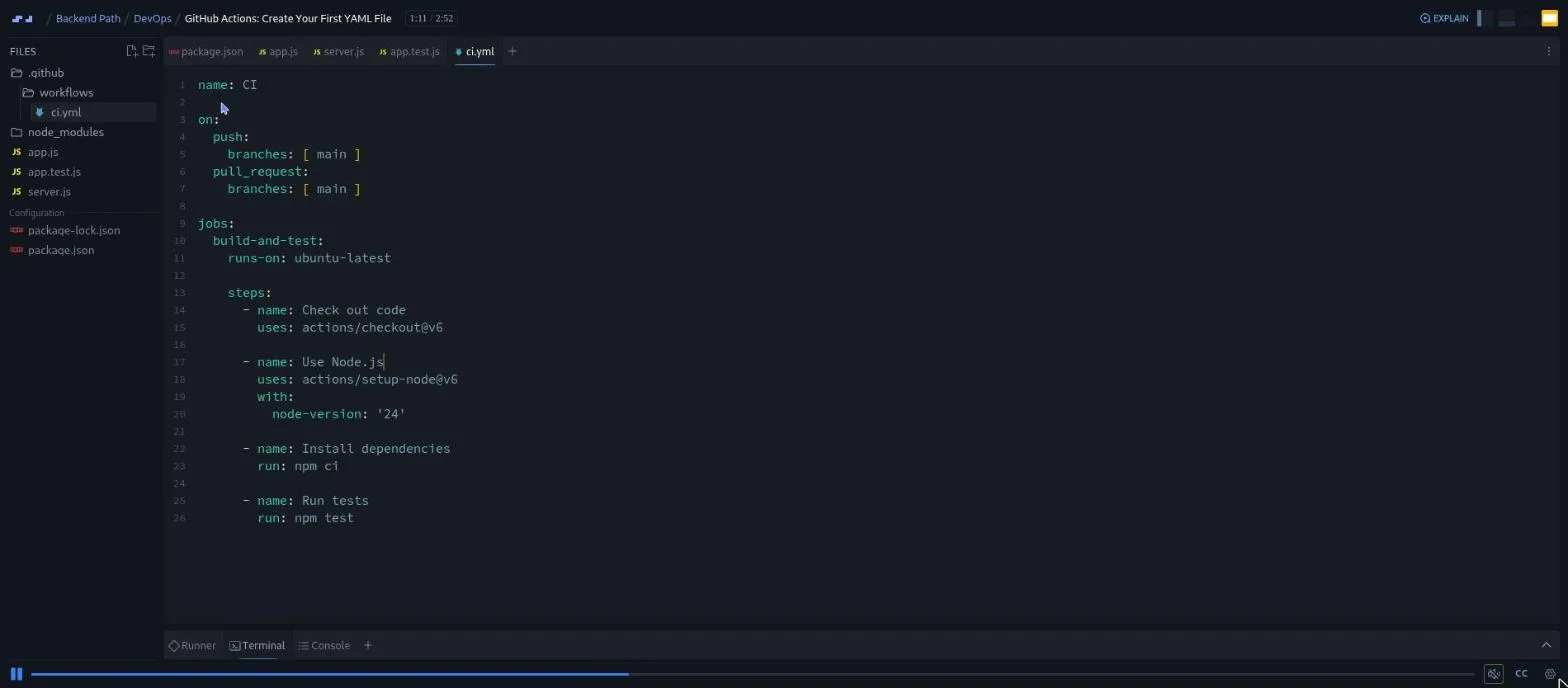
- DevOps (5.6 hrs) is the module you will not find in the Fullstack path: Containers & Docker (14 scrims), Deployment (15), Continuous Integration (23, GitHub Actions), Continuous Delivery (20) and Content Delivery Networks (nine, including DDoS protection).
- Launching Your Career (4.4 hrs) here is Data Structures and Algorithms (33 scrims, opening with "Mission: Save the Dinosaurs" and Big O) plus DSA Practice (55 scrims). No LinkedIn or interview-tips block; that lives in the Frontend and Fullstack paths.
Realistic time budget, in detail
The headline numbers up top assume lesson time only. Adding real builds:
- 6 to 8 hrs/week: about 8 to 10 weeks of lessons, longer with builds.
- 12 to 15 hrs/week: 3 to 5 weeks.
- Full-time, 30+ hrs/week: 2 to 3 weeks if you do not get sidetracked.
There is no cohort and no deadline. The study plan gives a structured week-by-week if you want one.
What the path doesn't cover
- JavaScript only. No Python and Django, no Java and Spring, no Go, no Rust. If you want a non-JS backend, this is not the path. Boot.dev and Codecademy carry more of that surface area; see Scrimba vs Boot.dev.
- Shallow on CS fundamentals. No algorithms course, no systems design, no concurrency deep-dive. Strong for shipping CRUD; thin for FAANG-style interviews.
- SQL is a working intro. Enough to query and model small schemas; not a database engineering course.
- Security is baseline. Auth, input safety, rate limiting. Useful coverage, not a substitute for a security specialization.
- Frontend is assumed. Start with Frontend or the Fullstack path if JS still feels new.
Who this is for
ZipRecruiter puts average U.S. back end developer pay around $120k as of May 2026, with the 25th to 75th percentile band spanning roughly $98.5k to $142k (ZipRecruiter Back End Developer Salary). The BLS publishes broader medians under Software Developers (BLS). Scrimba Pro sits in a very different budget tier than a bootcamp; live prices are at scrimba.com/our-pricing (opens in a new tab), and the student discount lowers that further if you qualify.
- You already know frontend basics and want APIs, data, and deploys.
- You are fine staying in Node and JavaScript rather than switching to Python or Go.
- Your job search targets backend or full-stack JS titles.
- You want a shorter Pro track than Fullstack without losing the server material.
What learners report
Forum and Reddit threads agree on three things. The Backend path is finishable in a couple of months at a steady pace. Instructors get generally positive reviews, and Tom Chant comes up positively more than most. And landing a backend role takes extra projects beyond the path, not just the certificate (Scrimba forum thread on the Backend path, DonTheDeveloper review of Scrimba's career path style). The path is the spine, not the whole job hunt.
Backend vs Fullstack
| Feature | Backend Path | Fullstack Path |
|---|---|---|
| Duration | 36.2 hrs | 108.4 hrs |
| Starting point | Intermediate (frontend assumed) | Zero |
| HTML / CSS / React | No | Yes |
| Node / Express | Yes | Yes |
| SQL / Databases | Yes | Yes |
| TypeScript | Yes | Yes |
| Next.js | No | Yes |
| AI Engineering module | No | Yes |
| Cybersecurity module | Yes | No |
| Testing module | No | Yes |
Fullstack rebuilds the frontend from scratch then adds everything else. Backend skips that 50+ hour rebuild if you do not need it.
Courses in this path
The standalone courses that map into this track, so you can read each review or take just one:
- Learn SQL (Beginner, Free, 3.8 hrs)
- Learn Node.js (Free, 3.5 hrs)
- Learn Express.js (Free, 4.0 hrs)
- Intro to NestJS (Free, 1.4 hrs)
- Learn TypeScript (Free, 4.2 hrs)
- Learn Regular Expressions (Free, 46 min)
- Intro to Supabase (Free, 4.8 hrs)
- Learn Cybersecurity (Pro, 5.0 hrs)
- Learn Git and Github (Pro, 1.7 hrs)
Cybersecurity here is a module inside this path (and a standalone course), not a separate career track.
Choose this if
You can already ship a UI and now want routes, SQL, hosting, and a baseline of security without sitting through the whole Frontend arc again. Want zero-to-hero in one subscription? That is Fullstack. Want a non-JS backend like Python or Java? Scrimba is not that platform.
The Backend Developer Path
ProNode, Express, SQL, TypeScript, cybersecurity baselines, Git, deployment. Pro path for devs adding server skills.
Start the Backend Path (opens in a new tab)Related pages
- All Learning Paths
- Fullstack Developer Path
- Frontend Developer Path
- Learn Node.js
- Learn Express
- Learn SQL
- Learn Cybersecurity
- Backend Courses
- Scrimba vs Boot.dev
- How Scrims Work
- Tutorial Hell FAQ
- Scrimba Pricing
Sources
- Scrimba: The Backend Developer Path (opens in a new tab)
- ZipRecruiter: Back End Developer Salary (May 2026)
- BLS: Software Developers, QA Analysts, and Testers
- Scrimba forum: C# course and Backend Dev Path
- Scrimba: How to become a backend developer in 2026
- DonTheDeveloper: Honest review of Scrimba's career path
Yes. The path is labeled Intermediate and assumes you already know basic JavaScript, HTML, and how the web works.
JavaScript and TypeScript on Node.js, with SQL for databases. Express is the main framework with a NestJS preview.
36.2 hours of lessons across 12 modules. Most learners finish in 3 to 5 weeks at 10 to 15 hours per week.
No. Scrimba's backend path is JavaScript-only. For Python backend development you will need another platform.